Posted by David Porter on September 23, 2015 · 2 Comments
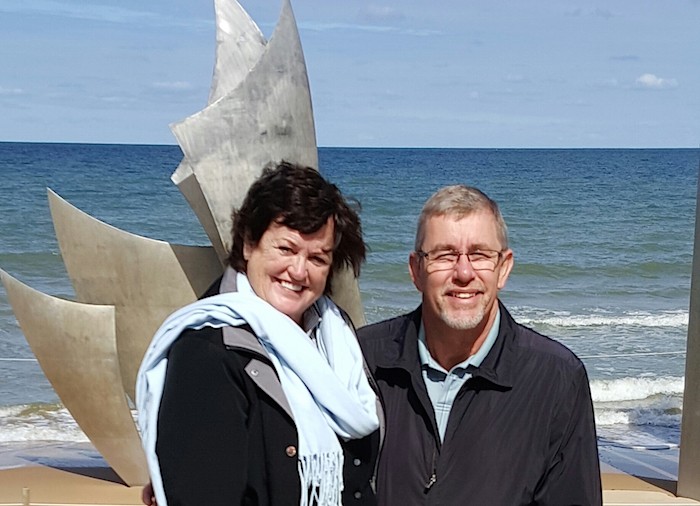
 As a travel photographer, I get a kick out of the opportunity to share selfie photographs that our clients send us to share with our readers. This is Ann and Jim from Michigan with one of the Normandy Beaches behind them.
We helped Ann and Jim put together a Paris to Normandy river cruise with Avalon Waterways topped off with an extra few days in Paris. When we made our welcome home call to Ann, she had nothing but glowing reports from the whole experience.
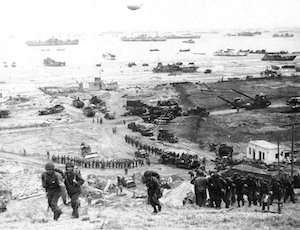
The Normandy Beach photo from Ann and Jim sure looks a lot different than the World War II U.S. Defense Department photograph to the right, don’t you agree?
You know, folks travel for all kinds of reasons, and one of the great motivators for travel is to create an emotional connection with a destination like the Normandy Beaches in France. Ann’s father landed on Normandy Beach in World War II and I’m quite confident that Ann experienced an emotional connection as she stood on this beach and contemplated the courage of her father as he experienced this horrific day in the world’s history.
How about you? Is there a destination in the world that would hold a significant emotional connection for you? If so, we’d be honored to help you plan such a travel experience as well.
If you would like us to help you plan a special travel experience complete with luxurious complimentary perks, give us a call at (480) 550-1235 or use our convenient online information request by clicking here.
If you enjoyed this article, sign up for our monthly newsletter to keep abreast of our best travel tips, on-location reviews, exclusive travel offers, group travel events, and much more.

Posted by David Porter on September 22, 2015 · Leave a Comment
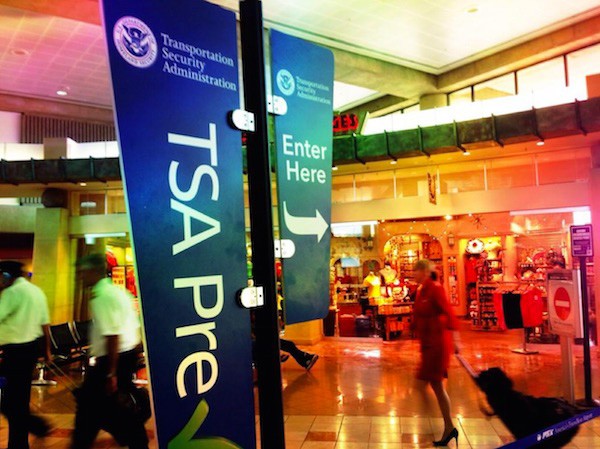
 Travel Alert: TSA Ends Free Inclusion to Airport PreCheck Lanes
If you’ve been enjoying free inclusion to the airport PreCheck lanes, the TSA wants you to know that the party’s over.
Here’s the scoop from ASTA:
The Transportation Security Administration (TSA) has confirmed to ASTA that effective September 14 it phased out its “Managed Inclusion” program that permits members of the public to use the PreCheck lanes at airports without being a paid member of the program or another trusted traveler program.
In June of this year, the TSA indicated the program would be phased out given security concerns. ASTA advises member agents to consider warning impacted customers accustomed to using the PreCheck lanes that they will no longer be able to without enrolling in the program if they have not done so already.
Specifically, TSA recommends that travelers who want to keep receiving TSA PreCheck on a consistent basis enroll in one of the four trusted traveler programs offered by the U.S. Department of Homeland Security:
To learn more about these programs, and to view a comparison chart of the benefits, visit www.dhs.gov/tt.
Q&As developed by TSA’s Public Affairs office can be viewed here.
If you’re a frequent airline traveler, we highly recommend that you enroll in one of these programs. Carol and I have been members of the Global Entry Program for years, and we really enjoy the benefits of a speedy journey through the airports.
If you enjoyed this article, sign up for our monthly newsletter to keep abreast of our best travel tips, on-location reviews, exclusive travel offers, group travel events, and much more.
Posted by David Porter on September 22, 2015 · Leave a Comment
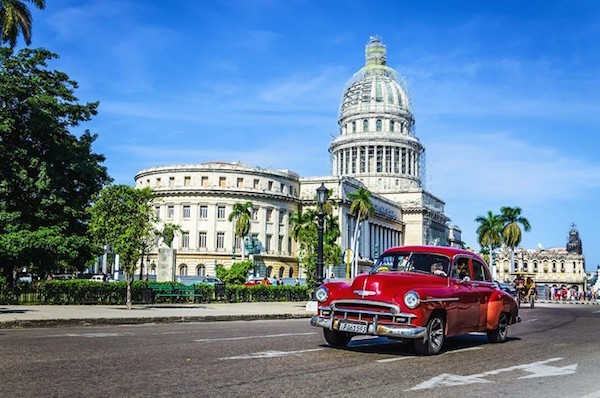
 A common question we receive from our travel readers is regarding solo travel to Cuba. It seems that there are a lot of people who want to explore the land of Papa Hemingway.
Well, as of this date, only group “person to person” travel is permitted. Here’s the latest from the American Society of Travel Agents (ASTA):
“The U.S. Treasury Department’s Office of Foreign Assets Control (OFAC) announced new regulations to further implement the policy changes announced by President Obama in December 2014 to engage and empower the Cuban people. The new regulations will be issued in the Federal Register on Monday, September 21 and will be effective immediately.
Among other things, the changes will authorize Americans and American companies to establish a physical presence in Cuba and to open and maintain bank accounts in Cuba; allow Americans to provide goods and services to Cuban national individuals located outside of Cuba; and expand licenses related to telecommunications and internet-based services.
With regard to the travel part of the Cuba regulations, the package makes only limited changes, including:
Carrier Service by Vessel/Lodging Services. The new regulations will allow Americans/American companies to provide carrier services by vessel without the need for specific licenses from OFAC, and add an authorization to provide lodging services aboard such vessels in connection with such transportation.
Family Visits. OFAC will now allow Americans and their family members to visit a close relative located in Cuba or accompany a close relative traveling to Cuba for certain purposes.
Bank Accounts for Authorized Travelers. The new rules allow all authorized travelers to open and maintain bank accounts in Cuba in order to access funds while located in Cuba for authorized transactions.
The new rules do not include a change mentioned in a recent Wall Street Journal article – the creation of an individual license for “people-to-people” cultural exchange travel. Today, to participate in “people-to-people” travel, Americans must travel as part of a group tour.
ASTA will continue to push for that change as well as for enactment of the Freedom to Travel to Cuba Act (S. 299/H.R. 664), which will overturn the statutory Cuba travel ban once and for all. We will also keep our members advised on the latest developments on Cuba travel regulations and legislation.”
To learn more about what Cuba travel options are available today, click here.
If you enjoyed this article, sign up for our monthly newsletter to keep abreast of our best travel tips, on-location reviews, exclusive travel offers, group travel events, and much more.
Posted by David Porter on September 12, 2015 · 1 Comment

Click photo for larger view. ©2015, David A. Porter
I snagged this photograph of Durnstein Castle while sailing with Viking River Cruises on the Danube River in Austria.
Here’s the scoop on the castle from Wikipedia:
“The Kuenring family had bought the area surrounding the castle from the Tegernsee Abbey in the late 11th century. Hadmar I of Kuenring, who had also founded Zwettl Abbey, had the present castle constructed in the middle of the 12th century in a strategic location overlooking the river Danube. The castle is connected to the city of Dürnstein through a defensive wall extending from the city walls.
The castle is known for being one of the places where Richard I of England was imprisoned after being captured near Vienna by Leopold V, Duke of Austria, in 1192.
In 1428 and 1432, Hussites plundered city and castle of Dürnstein.
Near the end of the Thirty Years’ War, Swedish troops under Lennart Torstensson conquered Dürnstein in 1645. Upon their departure, they destroyed parts of the structure. As of 1622, the castle was no longer inhabited permanently, but was still listed as a possible shelter in the Austro-Turkish War (1663–1664). In 1663, Conrad Balthasar of Starhemberg purchased the castle, which is still owned by his heirs to this date. From 1679 on, however, the castle was no longer habitable and was abandoned.”
There is a path that visitors can hike up to view the castle and enjoy a panoramic view of the Danube. However, we opted for a tour of the Durnstein Abbey with an organ recital instead. I’ll tell you more about the abbey in another post. 🙂
If you enjoyed this article, sign up for our monthly newsletter to keep abreast of our best travel tips, on-location reviews, exclusive travel offers, group travel events, and much more.
Posted by David Porter on September 12, 2015 · Leave a Comment
 I hate to learn things the hard way. Don’t you?
Quite a number of years ago, Carol and I were standing just outside the Pantheon in Rome and had run out of the cash supply that we brought with us to Italy. It was a beautiful sunny Sunday afternoon, so we headed to a nearby bank ATM to get some cash.
Horror of horrors, my bank declined the transaction, and there we were with no cash! Why did this happen? My bank wasn’t accustomed to seeing cash withdrawal requests from my card outside the U.S. So, the transaction was declined. And, as this was back before worldwide cell phone use was prevalent, we had no easy way to call our bank from the street. So, we had to borrow money from friends, take a taxi back to our hotel, and make an expensive international call from our hotel room.
Moral to the story? Call your financial institutions before you travel overseas!
Travel Tip: Alert Bank and Credit Card Companies Before Overseas Travel
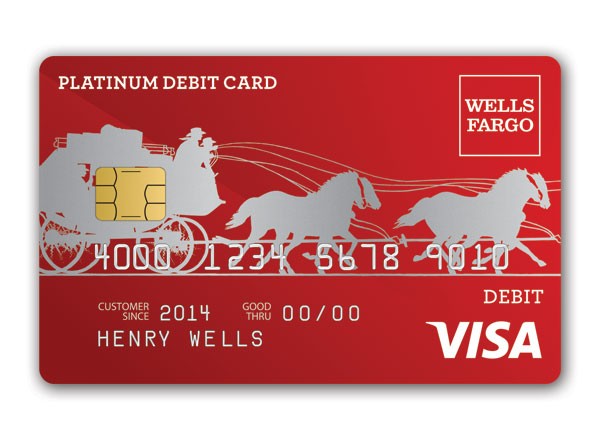
- Call your credit card company – every credit card company has a different procedure when they notice overseas charges on your credit card. If you are heading overseas for the first time, it’s imperative that you call your credit card provider and let them know that you will be making charges from overseas. If you’re a frequent overseas traveler, let them know that, and you won’t have to call each time. Imagine have a romantic dinner in Paris and your credit card it denied! :O Oh, while you’re talking to your credit card company, ask them if they are going to charge you currency transaction fees. If you plan to spend a fair amount of money overseas, you may want to make certain to use a card that doesn’t charge these fees. They can really add up!
- Call your bank – ATM machines are very prevalent around the world these days. Therefore, carrying large amounts of cash for your trip is no longer necessary. Nor, do you really needs those travelers checks of days gone by. However, just like your credit card, your bank might deny a cash withdrawal from you overseas if they’re not accustomed to seeing such requests from your debit card. So, give ’em a call before you leave. Also, be very leery of an ATM machine that is not attached to a bank. Scam artists have peppered the big cities of the world with ATMs that can scan and keep your personal information. And then, the next thing you know, your bank account will be cleared out. :O
If you don’t care to sit on hold with your financial institution, many of them will allow such notifications over the Internet. What ever the case, be certain to let them know that you’re going to have overseas charges and withdrawals. You have now been officially warned! 🙂
If you enjoyed this article, sign up for our monthly newsletter to keep abreast of our best travel tips, on-location reviews, exclusive travel offers, group travel events, and much more.
 The Roaming Boomers