The Roaming Boomers
European River Cruise Low Water: Best Time to Go?

Viking river cruise ship sailing the Danube in Durnstein, Austria
European River Cruise Low Water: Best Time to Go?
European river cruise low water is an important consideration when planning a journey on the Danube, Rhine and other European rivers. So, when is the best time to go if you want to reduce the risk?
We generally recommend April through June.
Most European river cruises begin operating in March. By April, winter snowmelt and spring rainfall generally provide good river conditions, making prolonged low-water problems less likely.
Spring isn’t risk-free. Heavy snowmelt and spring rains can occasionally produce high water, which can also disrupt navigation. But when choosing our own river cruises, we’re generally more concerned about the potential for low water later in the summer.
 When Does Low Water Become a Concern?
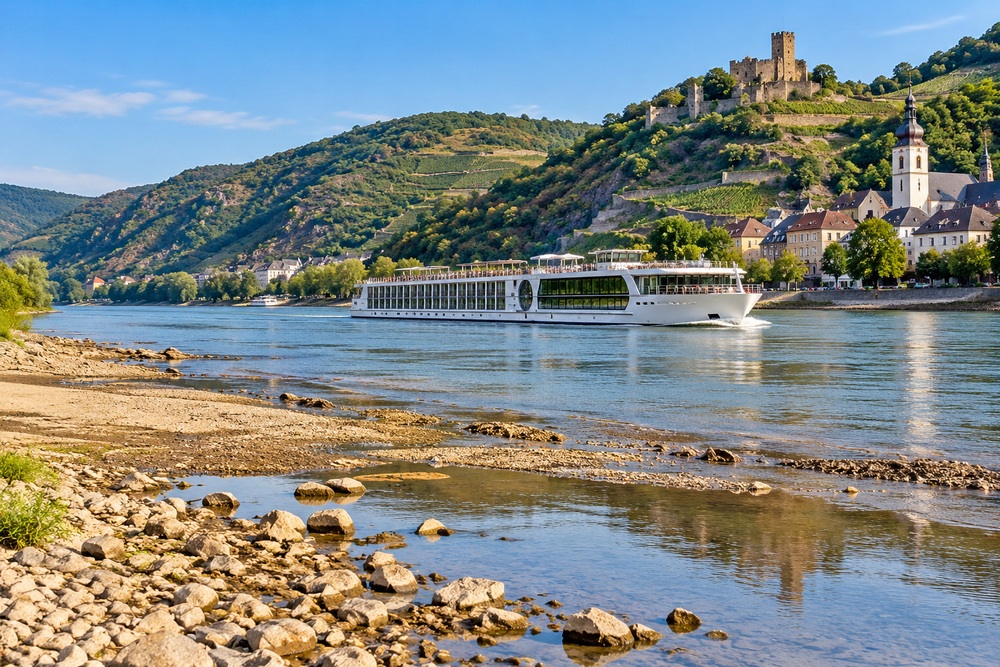
July and August are generally the months when we pay closer attention to low-water conditions on the Danube and Rhine. Prolonged summer heat and insufficient rainfall can cause river levels to fall, sometimes to the point where ships can’t safely navigate certain sections.
And that’s an important point: the entire river doesn’t have to be low. A single shallow section can force a cruise line to modify an itinerary, change docking locations, use motorcoaches or transfer guests between ships.
In particularly dry years, low-water problems can continue into September. Europe experienced significant low-water conditions in 2022, with notable low-water conditions returning again in 2026.
That doesn’t make July, August or September bad months for a river cruise. Many cruises operate normally. It simply means the risk can be greater than it is in spring.
River conditions can also change quickly. Rainfall upstream can improve conditions, while several weeks of hot, dry weather can do the opposite. No one can reliably predict river levels six months or a year before your cruise.
 Protect Your River Cruise Investment

For clients booking a Danube or Rhine river cruise in July or August — or September when significant low-water conditions persist — we strongly recommend travel protection with a meaningful Cancel For Any Reason option (CFAR).
We’re not necessarily talking about typical third-party CFAR policies, which we generally don’t recommend to our clients. Some river cruise companies offer their own travel protection programs with valuable cancellation provisions.
Viking is a good example. Viking’s Travel Protection Plan includes a Cancel For Any Reason Waiver. Subject to the plan’s terms and conditions, guests canceling for a reason not otherwise covered by the insurance portion of the plan can receive the nonrefundable portion of their Viking trip cost in Viking travel vouchers.
That can be extremely valuable if significant low-water conditions develop before your departure and you’re concerned that your itinerary may be substantially affected.
Every cruise line’s program is different, and terms and benefits can change. We’ll help our clients understand the applicable protection options when they book.

Carol enjoying a morning coffee on a Rhine River cruise in April
When Do Carol and I Take River Cruises?
Carol and I have taken 14 European river cruises over the past 12 years, and when we’re choosing dates for ourselves, we generally look first at April or very early May.
Water levels are part of the reason. In our experience, we’ve had little concern about low water during this period.
There are other advantages, too. The large summer crowds haven’t arrived, temperatures are generally cooler, and exploring Europe’s cities and riverside towns can be much more pleasant. July and August, by comparison, can be very hot.
So while April through June is our general recommendation for travelers who want to minimize low-water risk, our personal preference is April or very early May.
The Bottom Line
There is no completely risk-free time to take a European river cruise. But if you have flexibility, April through June is our preferred window for the Danube and Rhine.
If you choose July or August, or September during a particularly dry year, understand that low-water risk can be higher and make sure your travel investment is appropriately protected.
Understand the risk. Have an exit strategy. And protect your river cruise investment.
 Planning a European River Cruise With Roaming Boomers Travel Services
Low water is one of the realities of European river cruising, but it shouldn’t keep you from enjoying these wonderful journeys.
The key is understanding when low-water risk tends to be greater, choosing your travel dates thoughtfully, and knowing your options should river conditions become a concern before your trip.
At Roaming Boomers Travel Services, we’ve sailed Europe’s rivers many times ourselves and use that firsthand experience to help our clients choose the right river cruise line, itinerary, and time of year.
We can also help you understand the travel protection options available from your cruise line so you’re better prepared if low-water conditions threaten to significantly affect your journey.
If you’re considering a European river cruise on the Danube, Rhine, or elsewhere in Europe, we’d be delighted to help. For more information or to begin planning, please call (480) 550-1235 or submit our online information request by CLICKING HERE.
If you enjoyed this article, sign up for our travel newsletter to keep abreast of our best travel tips, on-location reviews, exclusive travel offers, group travel events, and much more.

This article was written with the aid of ChatGPT. Roaming Boomers Travel Services is an independent affiliate of Cadence and a Virtuoso® member. CST#201120-40
Our Client Testimonials


Research Travel Options

Best Way to Book a Cruise